Puzzle #19 Solution and Puzzle #20, “Stand-Ins”

S

P

O

I

L

E

R

S

P

A

C

E

Last week’s puzzle, titled “Go With Plan B,” asked for a five-letter category and featured five long across theme entries:

HAND GRENADE
LOUSY CAR
COMPUTER MAKER
FIVE-HOLE
QWERTY PHONE

Some of these evoked a certain category fairly readily: a lousy car is a LEMON, a leading QWERTY phone is a BLACKBERRY, and (going back to the well) a top computer maker is APPLE. With a little extra thought (maybe) you could land on either PINEAPPLE or POMEGRANATE for hand grenade, and NUTMEG for five-hole. (And yes, while it isn’t the first thing that comes to mind, nutmeg is a fruit! Most of us are familiar with consuming the ground-up seed, or [I didn’t know this] the red seed-covering aril, which is what makes the spice mace – but the internet tells me there are those who make jams and candies and whatnot with the fruit itself.)

The twist was that instead of extracting one letter from each theme entry as one might have expected, it turned out that when you put these in grid order their first letters spelled out PLAN B as mentioned in the title. So the answer was just FRUIT, which is five letters by happenstance, and is the unifying category for how to “go with plan B” in terms of what you call the five themers.

39 people submitted the correct answer. Next up, Puzzle #20, called “Stand-Ins.”

020_standins.puz

The answer to the metapuzzle is a common surname. Submit your answer using the contact form by Monday, July 29 at 11 p.m. Pacific Time. I’ll post the solution, and a new puzzle, next Tuesday.

To keep up with the puzzles: Twitter @pgwcc1; follow the blog for email reminders; rss feed if you’re set up for that.

Puzzle #18 Solution and Puzzle #19, “Go With Plan B”

S

P

O

I

L

E

R

S

P

A

C

E

Last week’s puzzle featured kind of a red herring: I asked for a kind of sandwich, and gave you a puzzle titled “Triple Deckers” with nine three-entry stacks in which the middle entry was clued only as “see grid.” Surely the theme must be built around these visual “sandwiches,” right?

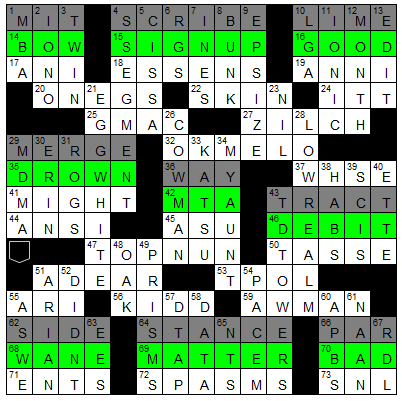
Wrong. The bottom bit of each triple decker was irrelevant, actually. Instead, all that was going on was that each entry lacking a clue could be clued by a word formed by adding the prefix “sub” to the entry above it – so, e.g., 14-across BOW could be clued as “submit” – and it sits in the grid under (or SUB) the entry MIT. And so on:

So the meta answer was just SUB, which happens to be a kind of sandwich, but sandwiches didn’t otherwise have anything to do with the meta.

21 solvers submitted (ha!) the correct answer. Now we move on to Puzzle #19, “Go With Plan B.” Will this puzzle yet again be about sandwiches? You’ll have to solve it to find out ….

019_planb.puz

The answer to the metapuzzle is a five-letter category. Submit your answer using the contact form by Monday, July 22 at 11 p.m. Pacific Time. I’ll post the solution, and a new puzzle, next Tuesday.

To keep up with the puzzles: Twitter @pgwcc1; follow the blog for email reminders; rss feed if you’re set up for that.

Puzzle #17 Solution and Puzzle #18, “Triple Deckers”

S

P

O

I

L

E

R

S

P

A

C

E

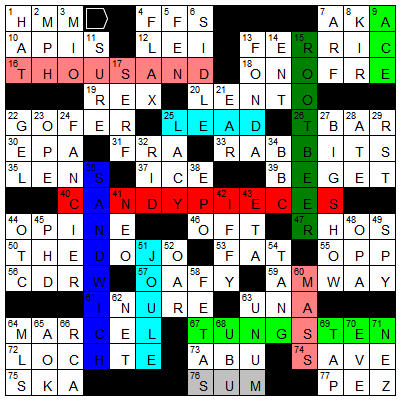
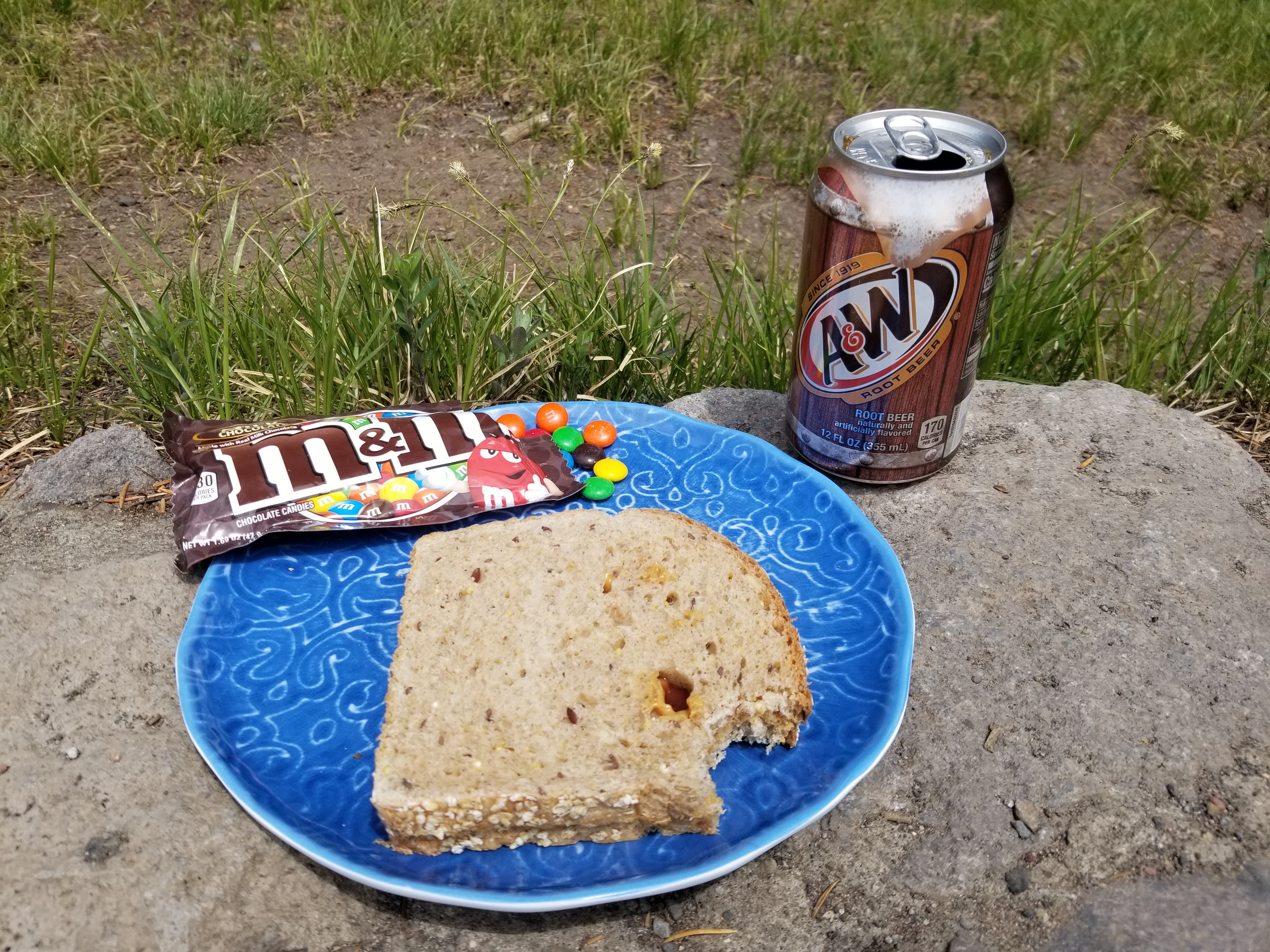
This cramped grid had three symmetrically-placed, longish food/drink answers with starred clues. With a nudge from the title you might have noticed that each of these types of food/drink has an example of the form “X&Y”:

40-across CANDY PIECES: m&m
15-down ROOT BEER: A&W
36-down SANDWICH: PB&J

A healthy, balanced meal …

Next, you can find entries around the grid that correspond to the letters of the “combos” above:

M = 16-across THOUSAND; M = 60-down MASS
A = 9-down ACE; W = 67-across TUNGSTEN
Pb = 25-across LEAD; J = 51-down JOULE

The last step is to treat the “&” of each combo as an arithmetic operation and add the clue numbers of each pair together, which it turns out gives you the same answer all three times: 16+60 = 9+67 = 25+51 = 76, which confirms itself as the meta answer by being the clue number for the entry SUM.

Next up is puzzle #18, “Triple Deckers.”

018_tripledeckers.puz

The answer to the metapuzzle is a kind of sandwich. Submit your answer using the contact form by Monday, July 15 at 11 p.m. Pacific Time. I’ll post the solution, and a new puzzle, next Tuesday.

To keep up with the puzzles: Twitter @pgwcc1; follow the blog for email reminders; rss feed if you’re set up for that.

Puzzle #16 Solution and Puzzle #17, “Combo Platter”

S

P

O

I

L

E

R

S

P

A

C

E

Three initial things to notice about last week’s puzzle: (1) the prompt asked for a phrase consisting of two eight-letter words; (2) the grid had eight seven-letter entries (and nothing longer); and (3) the title was “Cut Out the Middle, Man.” The middle letters of those seven-letter entries appropriately spelled out S-A-N-D-W-I-C-H. So far so good … but you need another eight-letter word. To get it you had to look to the clues, which contained eight six-letter words/phrases formed from the letters left over from the theme entries after you took out their middle letters. So, for example, the clue for 9-across, FBI, was “U.S. agency concerned with the law,” corresponding to 53-across THE CLAW. The first letters of the entries whose clues contained those six-letter words/phrases, in the order in which they appear in the grid, spell out F-I-L-L-I-N-G-S, so your meta answer was SANDWICH FILLINGS.

Though it was several steps, most of you found this one on the easier side. I don’t have final numbers as I write this – I will be on the road by the time this posts – but at least 47 people solved it.

Next up is #17, “Combo Platter.”

017_comboplatter.puz

The answer to the metapuzzle is a two-digit number appearing in the grid. Submit your answer using the contact form by Monday, July 8 at 11 p.m. Pacific Time. I’ll be returning from vacation that day – maybe late – so I can’t guarantee the solution and next puzzle will be up as usual on Tuesday morning. We’ll see what happens.

To keep up with the puzzles:
Twitter @pgwcc1; follow the blog for email reminders; rss feed if you’re set up for that.
Puzzle #15 Solution and Puzzle #16, “Cut Out the Middle, Man”

After the previous week’s puzzle that required a bit of Spanish, this week I gave you a puzzle in which it was pretty clear from the title (French for “strange exchange”) that there was going to be French involved. The meta instructions asked for a plural that’s five letters in English. Here’s how to get there:

I wanted 50-down to be NO BOAT, a humorous way in which I was once goaded into ordering fries at an In-N-Out (“just write ‘fries no boat’ on the ticket, please” … [fry cook looks at ticket, shrugs, dumps fries into bag on top of burger]) – but whereas other “secret menu” items have hundreds of thousands of google hits, “fries no boat” has … six. So I don’t really think it’s much of a thing.

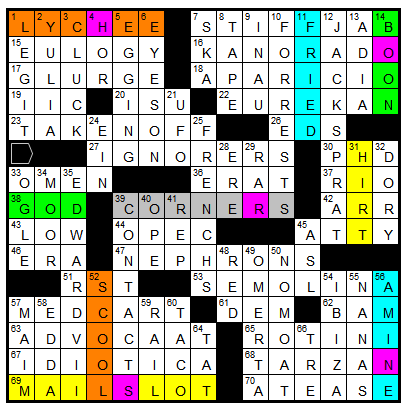
Depending on whether you solved the hard or easier version, you either got a subtle hint, or explicit instructions, that the CORNERS were important. How that worked was that each corner of the grid began or ended one entry that you could turn into a French word by removing one letter. Scattered throughout the rest of the grid were partners for those entries that, by taking on the discarded letters, could become an English synonym for the French word. So for example, 1-across LYCHEE loses the H to become lycee, which translates to school, which is 52-down ‘SCOOL with an H inserted into it. Similarly:
B(O)ON -> G(O)OD
AMI(N)E -> FRIE(N)D
MAIL (S)LOT -> (S)HIRT

In grid order, those four “exchanged” letters spell out HONS, which is neither a five-letter English plural nor is it a French word (unless you want to translate it as “sounds repeated by stereotypical laughing Frenchmen like Maurice Chevalier“). What next? If you did the easier version you had a hint to go back to 39-across and consider it as another theme entry, and if you did that you saw that if we take the second R out of CORNERS, we are left with cornes, which in French means horns, which of course is HONS with an R inserted into it, so HORNS is the meta answer. If instead you did the hard version, you just had to see that the most natural thing for HONS to take on to make it a five-letter plural is an R, and oh hey, if you take an R out of that central entry that was already important to the meta, that gives you the French word for horns; plus, the “exchanged” letters spell out HORNS in grid order. While a few solvers expressed uncertainty about this step, it seems to me it would have been astoundingly unlikely for all of that to be a coincidence, so while the motivation for trying it might not have felt intuitive, the confirmation once you did try it ought to have been solid. But as always, your mileage may have varied …

I hope the French language knowledge required for this solve wasn’t too high a hurdle for too many people. I felt like most of the French words involved in the solve were pretty accessible. AMIE has appeared in the NYT crossword 134 times in the Will Shortz era; BON, 38 times; and LYCEE, 14 times. MAILLOT only has 2 appearances but it ought to be known to even casual observers of the Tour de France as part of the phrase maillot jaune, the yellow jersey worn by the race’s leader. (Anyway, I was too excited to find MAIL (S)LOT -> (S)HIRT to pass it up.) The most obscure pair was the final one – CORNE has only been in the NYT crossword once, pre-Shortz in 1977. (It was clued as “French horn.”) But at that point, you had H-O-N-S and there aren’t a ton of ways to make that into a 5-letter plural; plus if you know some etymology you may be familiar with the word part “corn” meaning horn as in unicorn, cornucopia, cornet, etc. …

28 solvers submitted the correct answer, and even some of you whose limited French vocabulary made it especially difficult told me you particularly liked this one. Merci beaucoup!

Okay, enough Romance languages! This week’s puzzle, “Cut Out the Middle, Man,” has a few foreign entries (including one pretty obscure Slavic orthography term … sorry for that) but the meta should not be easier or harder depending on what language you studied in high school – promise.

016_cutmiddle.puz

The answer to the metapuzzle is a phrase consisting of two eight-letter words. Submit your answer using the contact form by Monday, July 1 at 11 p.m. Pacific Time. I’ll be traveling next week, so the solution, and a new puzzle, will be auto-posted next Tuesday.

To keep up with the puzzles:
Twitter @pgwcc1; follow the blog for email reminders; rss feed if you’re set up for that.
Puzzle #14 Solution and Puzzle #15, “Étrange Échange”

S

P

O

I

L

E

R

S

P

A

C

E

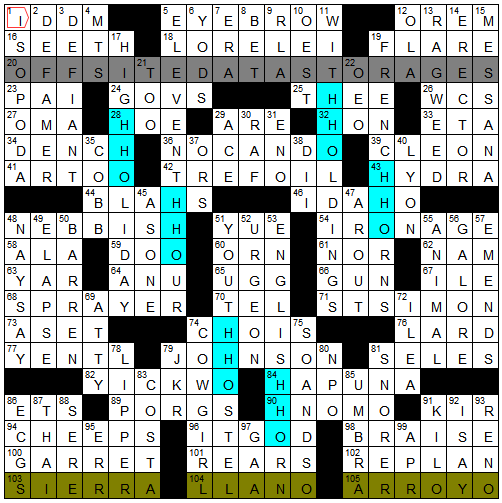
Last week was a visual meta. The 19-letter entry at the top, OFFSITE DATA STORAGES, was clued as “Clouds,” and six lengthy down entries contained the trigram HHO, representing raindrops falling from those clouds. That was easy enough to see, but how did that yield a familar rhyme? It didn’t really – at least, not without some extra theme material running across the bottom of the puzzle:

Those three Spanish-language entries, all clued with fill-in-the-blank geographical names, were no coincidence; instead they represented the terrain on which the raindrops will fall – SIERRA (mountains) to the west; ARROYO (literally “creekbed,” often used to refer to a valley, draw or canyon in placenames) to the east; and in the center, LLANO.

At this point in the solve having some knowledge of Spanish, and/or having lived in the part of the U.S. that was once Mexican territory, was certainly an advantage. LLANO, which literally means “flat,” is used in some placenames to mean “plain.” Most notably, the example used in the clue – the Llano Estacado or “Staked Plain” of Texas. Near me, there is an old Spanish land grant called the Llano Seco – dry plain – which lives on in the name of a ranch known locally for pork, and beans, and now I’m hungry …

Anyhow, the rainfall is toward the center of the grid – only one drop each is going to hit the mountains and the valley, two drops will land on the borders, and two will land squarely on the plain itself. So the answer to this visual puzzle, which called for a familiar rhyme, was THE RAIN IN SPAIN STAYS (or falls) MAINLY IN (on) THE PLAIN, the rhyme made most famous as a pronunciation drill in “My Fair Lady.”

While the use of “llano” to mean plain seems more common in the Americas, I did find a couple of small Spanish towns named, e.g., Llano de Brujas. At any rate I felt that if you noticed “hey all these geographical terms at the bottom are in Spanish” it would be enough to get you thinking in the right direction, and if you looked up Llano Estacado you would see the “plain” translation. Maybe the clues should have used the names of places in Spain itself, though that would have required two clues referencing highly obscure places.

Solvers had varied reactions to this one. Some didn’t notice the Spanish terrain at the bottom, and sent in rhymes relating to rainfall; but even some who did submit the right answer commented that the answer didn’t feel like it fully “clicked” from the visual clues. I’m not sure how to account for this; I had expected that, assuming you noticed the Spanish names for kinds of terrain at the bottom, the picture would be clear enough – the plain is in the middle, and most of the rain is in the middle. Certainly different clues (“the mountains, in Spain”; “the plain, in Spain”; “the riverbed, in Spain”) would have helped, but at that point I feel like I would have been hitting you over the head with it.

Others had some nits to pick – is the rain is this grid really mostly falling onto the plain? isn’t water’s molecular structure more like HOH? do they really use “llano” to mean “plain” in Spain, or is that a Latin American thing? – but most of these folks said those issues didn’t detract from the overall solve.

Finally, several people commented that this puzzle’s fill was just a bit too ugly. I’ve always acknowledged that (a) I’m an inexpert constructor and (b) I am bad-fill-tolerant when it serves the meta – but I do see, looking back at this one, that I settled for obscure entries too many times. Noted.

For this week’s offering I’m once again offering two versions, one harder than the other. I don’t think the easy version will be a gimme, though – but we’ll see how it goes:

Not-as-hard:

015_etrangeechange.puz

Hard:

015_etrangeechange_hard.puz

The answer to the metapuzzle is a plural noun that is five letters in English. Submit your answer using the contact form by Monday, June 24 at 11 p.m. Pacific Time. I’ll post the solution, and a new puzzle, next Tuesday.

To keep up with the puzzles:
Twitter @pgwcc1; follow the blog for email reminders; rss feed if you’re set up for that.
Puzzle #13 Solution and Puzzle #14, “Dropping Hints”

S

P

O

I

L

E

R

S

P

A

C

E

For last week’s puzzle “Look – Behind You” we were looking for a seven-letter plural. Solvers had to notice that seven of the grid’s entries could satisfy the clue if you tacked a letter onto the beginning – and not just any letter, but (in keeping with the puzzle title) the letter preceding it (on the other side of a black square) in the grid:

Those single letters appropriately spelled out HYPHENS, which would typically be used in spelling out these expanded versions of the theme entries as shown above.

The easy version made this a lot easier to see by starring the clues for the seven theme entries, and also lightened up on the cluing in several places. Those who solved the hard version had to notice that in a few cases, the answer felt vaguely like it was missing something – BOMB and AXIS were maybe leading candidates for triggering that realization – or else just have the idea to “look behind” the across entries and start seeing the pattern.

One extra note, which I’ll try to keep brief. If you recall the controversy over Puzzle #10, surely you noticed that this week’s theme contained an echo of that which in retrospect I really should have changed – 68-across ought to have been, say, TUPLE (shifted over to 70-across) rather than WORD. How could I have been so dense as to run a theme with a reference to the same super-offensive concept again, just three weeks later? The truth is I just didn’t think about it; this week’s puzzle was constructed months ago, and was never meant as any kind of call-back to #10. And I am honestly dumb enough that – even after week 10 – it didn’t occur to me that the phrase that supplies the penultimate letter of this week’s meta answer, clued neutrally, might be upsetting to encounter in the process of solving.

The whole thing passed mostly without comment, and lots of people told me they liked this puzzle, but after I realized what I’d done and a couple of folks raised an eyebrow I felt no small amount of angst. I also got into a couple conversations on twitter this week about the extent to which it’s appropriate to fill grids with terrible people and things, a question on which my natural inclinations run toward “it’s fine, the world is full of awfulness so why shouldn’t puzzles be?” But I learned from those conversations – and from the experience in week 10 – that others have a different sensibility about that, and if I’m unwilling to be mindful of the experience of you the solvers, there is really no point in publishing these things. If your reaction to what I’m saying here is “you obviously didn’t learn well enough or fast enough,” I’m hard-pressed to argue. I can’t promise not to screw up again – my personal offense threshold is apparently pretty high – but I do promise to try harder to steer clear of stuff that is likely to touch nerves.

Your comments, either to this post or in private, are welcome. Moving on, 52 solvers submitted the correct answer to this one. I also went back and finally ran the numbers on weeks 11 and 12 – 20 people found the answer to Puzzle #11 (PIG, as in squeal like a); 14 people got #11a (GRAPE, as in grapefruit); and 23 people got #12 (AREA CODES). Next up: Puzzle #14, “Dropping Hints.” PDF, .puz, you know the drill:

014_droppinghints.puz

The answer to the metapuzzle is a familiar rhyme. Submit your answer using the contact form by Monday, June 17 at 11 p.m. Pacific Time. I’ll post the solution, and a new puzzle, next Tuesday.

To keep up with the puzzles:
Twitter @pgwcc1; follow the blog for email reminders; rss feed if you’re set up for that.

Puzzle #12 Solution and Puzzle #13, “Look – Behind You”

S

P

O

I

L

E

R

S

P

A

C

E

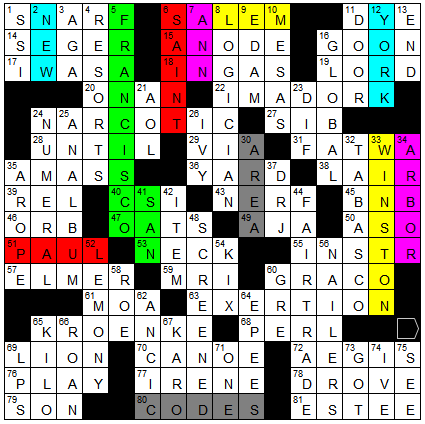
Last week’s 16×16 grid didn’t have obvious theme entries.  It was titled “Connect Five” and asked for a phrase formed by connecting two grid entries, and astute solvers noticed that connecting five pairs of grid entries yielded five two-word cities:

Those ten entries were arranged asymmetrically and mostly toward the top of the grid; what was going on? It turned out that the entries making up the city names were placed such that their grid numbers formed the AREA CODES used to call (or, ahem, connect to) those cities:

2d NEW + 12d YORK = NEW YORK (212)
33d WINSTON + 6a SALEM = WINSTON-SALEM (336)
41d SAN + 5d FRANCISCO = SAN FRANCISCO (415)
6d SAINT + 51a PAUL = SAINT PAUL (651)
7d ANN + 34d ARBOR = ANN ARBOR (734)

For the second week in a row I ran out of time to tally results – this time because I needed all weekend to solve Matt Gaffney’s strange and fiendish week 5. Next up here is puzzle #13, “Look – Behind You.” This week I’m including easy and hard versions from the outset. (Protip for those who start with the hard version and decide to switch to the easy: the only changes are in the clues, so no need to re-solve the grid.) As always, you can either download the .pdf below, or click on the link for the .puz file which is shared from Google Drive.

Hard version:

013_lookbehindyou_hard.puz

Easy version:

013_lookbehindyou_easy.puz

The answer to the metapuzzle is a seven-letter plural. Submit your answer using the contact form by Monday, June 10 at 11 p.m. Pacific Time. I’ll post the solution, and a new puzzle, next Tuesday.

To keep up with the puzzles:
Twitter @pgwcc1; follow the blog for email reminders; rss feed if you’re set up for that.
Puzzle #11 and #11a solutions, and Puzzle #12, “Connect Five”

S

P

O

I

L

E

R

S

P

A

C

E

In last week’s full-sized puzzle, “Do Like I Do,” I asked for a farm animal. The grid had six ten-letter entries, each an example of a thing that’s part of a familiar phrase of the form “[verb] like a [thing].” Hidden elsewhere in the grid were words that were one letter off from the verbs:

SALK -> WALK (like an Egyptian, such as OMAR SHARIF)
QAT -> EAT (like a bird, such as a KINGFISHER)
WOUK -> WORK (like a dog, such as a BLOODHOUND)
DEINK -> DRINK (like a fish, such as a RED SNAPPER)
LAVE -> LIVE (like a king, such as RICHARD III)
SLAKE -> SHAKE (like a leaf, such as a PINE NEEDLE)

The letters you need to change to make the phrases, in bold above, spell out (in grid order) SQUEAL, suggesting the phrase “squeal like a pig” – so the answer was PIG.

Puzzle #11a was simpler. It featured six entries with starred clues:

*Fish found in Louisiana bayous = GAR
*Cat found in India = TIGER
*King who founded a West African dynasty = KAYA
*City that’s the seat of Ecuador’s Napo Province = TENA
*Stone used to make arrowheads = FLINT
*Horn with a reed = SAX

The key here is that each thing can form a compound word or phrase if you add the kind of thing it is (which was also the first word of each clue), and as the puzzle’s title suggests, the compound word is not the same thing as the original word (nor does the newly formed compound word/phrase fit the clue). So, a garfish, while it is still a fish, is not the same thing as a gar and is not found in Louisiana bayous; a Tigercat is not a tiger at all but a fighter jet (or: a tiger cat is a much smaller cat than a tiger, not found in India); kayaking is a totally different thing from the obscure Ghanaian dynast Kaya Magan Cissé; tenacity is a totally different thing from Tena, Ecuador; a Flintstone is a cartoon character, not a kind of stone; and a saxhorn is still a brass instrument, but it’s not the same thing as a sax, and it’s played with a trumpet-style mouthpiece, not a reed.

So to what fruit can you add “fruit” and get a new and different thing? That would be the GRAPE, which is of course much smaller than a baseball – but a grapefruit sure isn’t.

I had a lot going on for the holiday weekend and haven’t run the numbers yet, but puzzle #11 in its original form was quite hard. The mid-week hint unlocked it for a lot of folks. #11a, meanwhile, vexed a lot more solvers than I would have predicted. Of those who clearly saw the first theme idea (make a new word with [thing] + [category]), quite a few apparently didn’t see the theme’s defining feature (new word ≠ original word); probably the most popular incorrect entry was KIWI. This surprised me a little, not least because while I’m no stranger to kiwis (I live in the heart of the main region for growing kiwis in the U.S.), and I’ve heard them called “kiwifruits,” it’s not (in my experience) a very common term vs. just kiwi itself; I’d have thought the first “[fruit]fruit” thing that would come to anyone’s mind would be grape anyhow. Another common pitfall was that solvers interpreted the prompt backwards, submitting e.g. grapefruit instead of grape (or kiwifruit, breadfruit, etc.) I’m not sure where my instructions went wrong but clearly this one was not presented in as straightforward a manner as I’d intended.

Next up is Puzzle #12, “Connect Five.” As always, you can either download the .pdf below, or click on the link for the .puz file which is shared from Google Drive.

012_connectfive.puz (link to .puz file)

The answer to the metapuzzle is a phrase formed by connecting two entries in the grid. Submit your answer using the contact form by Monday, June 3 at 11 p.m. Pacific Time. I’ll post the solution, and a new puzzle, next Tuesday.

To keep up with the puzzles:
Twitter @pgwcc1; follow the blog for email reminders; rss feed if you’re set up for that.


Puzzle #10 Solution; Puzzle #11, “Do Like I Do;” and Puzzle #11a

S

P

O

I

L

E

R

S

P

A

C

E

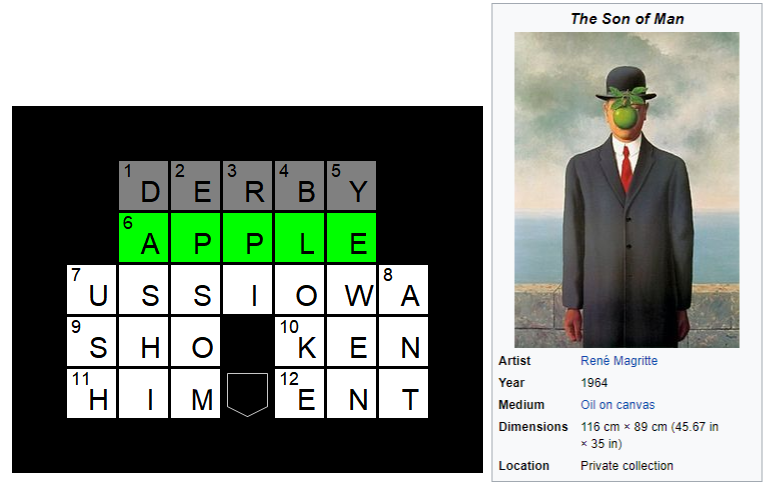
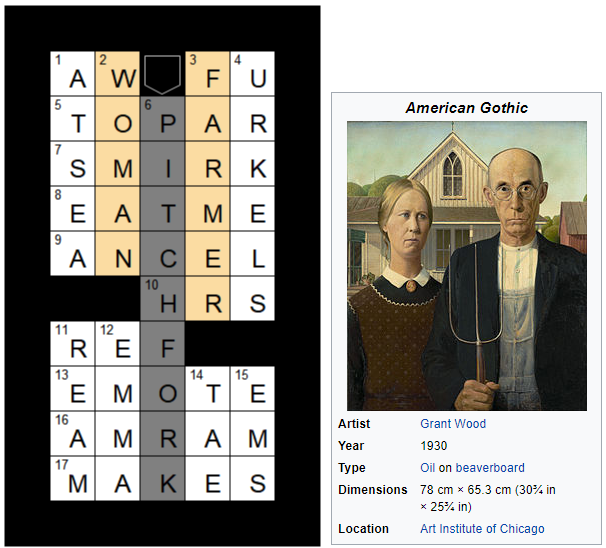
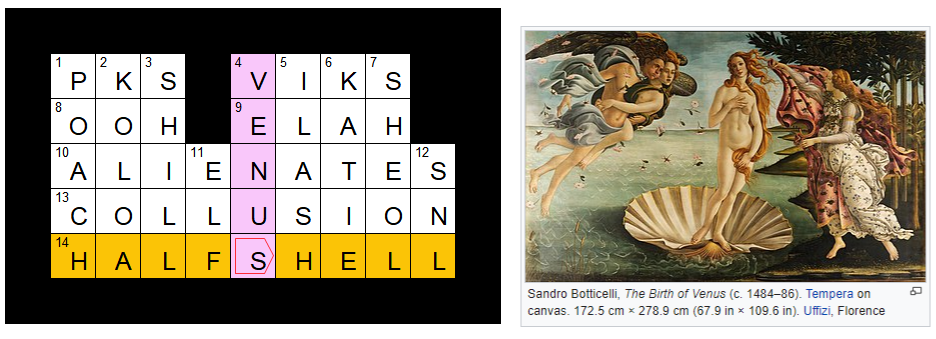
Last week we had a series of eight mini-puzzles, the answer to which was a heading you might see on an artist’s portfolio. And indeed there was a heavy art theme; with two exceptions (well, one if you solved the original version – more on that below), the grids represented famous paintings:

Artist: Claude Monet
This one breaks a few crossword conventions, which Warhol would certainly approve of
I sort of like how the grid shape vaguely resembles the hat
I know the prominent feature on the left is a stand of cypress trees, but it worked a lot better with steeple, which is in there too
Here we have the first non-painting, as indicated by the lack of a “frame” around the grid – instead it’s a work of architecture (the Pyramid in front of the Louvre) by I.M. Pei, who I can only assume was so gratified by this cruciverbal tribute that he finally felt ready – R.I.P., I.M.

The original version of the puzzle had a grid depicting Norman Rockwell’s The Problem We All Live With here. It, like the painting, contained a highly offensive term (I censored it, Rockwell did not). You can read more about that here; mid-week I replaced it with something different – a very famous photo, also featuring an icon of the Civil Rights era:

Leifer’s composition is better than mine; he had the right seat to get Ali in the center of the shot
This might be my favorite
“Keep it Casual” refers both to the nudity and also to the artist’s preference for his nickname, which as we’ll see is important to the meta solve

Once you found all those artworks, the series title was your clue to focus on the first names of the artists (Claude, Andy, René, Vincent, Ieoh, Neil/Norman, Grant, and [keeping it casual] Sandro); in order, their first letters spell out the artistic form CARVINGS.

Once again, I stretched the limits of reasonable crossword fill in a few places to make these little bits of grid art – I hope you’ll forgive me for weird entries like ILASH, KOLOA, and MIVI. But be thankful that I took another shot at the Van Gogh, my first draft for that grid was just hideous.

One regret, once I got to the end, is that I managed to choose eight – no, make that nine – works of art all by men, only one of whom isn’t a white guy.

43 solvers submitted the right answer. Next up is Puzzle #11, a 15×15 called “Do Like I Do,” and also Puzzle #11a, a little 9×9 called “The More Things Stay the Same, the More They Change.” puz and pdf options below.

011_dolikeido (link to .puz file)

The answer to metapuzzle #11 is a farm animal.

011_staysame (link to .puz file)

The answer to metapuzzle #11a is a fruit smaller than a baseball that could have been a seventh theme entry.

Update, Friday 5/24/19: having received very few solutions to #11, and some incorrect solutions to #11a, I’m providing updated versions of the puzzles below. The new #11 is meant to be a bit easier, with the help of some new clues (they’ll stand out if you get the pdf version); the new #11a is the same, but the meta prompt has been rewritten as follows: The answer to the metapuzzle is a word that could have been in this grid with the clue “*Fruit smaller than a baseball.” (This doesn’t change the prompt’s meaning but might help you avoid a trap a few people have fallen into.)

011_dolikeido_hint.puz

011_staysame_v2.puz

Submit your answers using the contact form by Monday, May 27 at 11 p.m. Pacific Time. I’ll post the solution, and a new puzzle, next Tuesday.

To keep up with the puzzles:
Twitter @pgwcc1; follow the blog for email reminders; rss feed if you’re set up for that.